Dental Hygiene in Prague: GBT vs Traditional Dental Cleaning – What's the Difference?
Regular professional dental hygiene is an essential part of preventing tooth decay and gum disease. Although many people associate a dental hygiene appointment mainly with tartar removal and polishing, modern dental cleaning goes much further. It focuses on removing bacterial biofilm, identifying potential problems early and helping patients maintain healthy teeth and gums over the long term.
One modern approach is Guided Biofilm Therapy (GBT), a structured dental hygiene protocol that incorporates AIRFLOW® technology and personalised preventive care. But how does GBT differ from traditional dental cleaning? Is it more comfortable? And what should you look for when choosing a dental hygienist in Prague?
At Stomatologické centrum Anděl, our dental clinic in Prague 5, we routinely use the GBT protocol for professional dental hygiene appointments. Here is what you should know before booking your visit.
Why is regular professional dental hygiene important?
Even with careful daily brushing, it can be difficult to remove all plaque, particularly between the teeth, along the gumline and in other hard-to-reach areas.
Dental plaque, also known as biofilm, is a community of microorganisms that continuously forms on the surfaces of teeth. If it is not removed regularly, it can contribute to tooth decay and gum inflammation. Over time, some plaque mineralises into tartar, also called dental calculus, which cannot be removed with an ordinary toothbrush.
One of the earliest warning signs of gum inflammation is bleeding when brushing or using interdental brushes. Untreated gum inflammation can, in susceptible individuals, progress to periodontitis – a condition affecting the tissues and bone supporting the teeth.
Professional dental hygiene helps to:
- Remove bacterial biofilm and tartar from areas that are difficult to clean at home.
- Reduce the risk of gum inflammation and other oral health problems.
- Remove surface stains caused by coffee, tea and smoking.
- Monitor gum health and identify potential problems.
- Improve brushing technique and the use of interdental cleaning tools.
The best long-term results come from combining effective daily oral hygiene with regular professional care.
GBT vs traditional dental cleaning: what's the difference?
Both approaches share the same fundamental objective: removing harmful deposits and helping to maintain healthy teeth and gums. The main differences lie in how treatment is organised and which technologies are used.
Traditional dental cleaning
Conventional dental hygiene generally involves removing tartar using ultrasonic scalers and hand instruments. Depending on the patient's needs, the hygienist may also polish the teeth using rotating brushes, rubber cups or other cleaning techniques.
When performed properly, traditional dental cleaning is effective and remains an established part of preventive dentistry. However, the exact treatment protocol can vary between dental practices.
Guided Biofilm Therapy (GBT)
Guided Biofilm Therapy is a structured, biofilm-focused approach to professional dental hygiene. The treatment includes applying a special disclosing solution that makes otherwise difficult-to-see plaque visible. This allows the dental hygienist to identify areas requiring attention and helps patients understand where they may need to improve their daily brushing technique.
Biofilm and surface stains are then removed using AIRFLOW® technology, which combines warm water, air and a fine, low-abrasion powder. Any remaining tartar can be removed with PIEZON® ultrasonic instruments or suitable hand instruments where necessary.
| Feature | Traditional dental cleaning | Guided Biofilm Therapy |
|---|---|---|
| Main approach | Plaque and tartar removal using professional instruments | Structured protocol focused on visualising and removing biofilm |
| Plaque disclosure | May be included | Standard part of the protocol |
| Biofilm removal | Mechanical cleaning, polishing and sometimes air-polishing | Primarily AIRFLOW® technology |
| Tartar removal | Ultrasonic scalers and hand instruments | Targeted PIEZON® scaling and additional instruments where necessary |
| Patient comfort | Depends on the techniques used and individual sensitivity | Fine powder and warm water may improve comfort |
| Home-care advice | May be included | An integral part of the protocol |
| Final assessment | Depends on the practice | Checking the cleaning result is part of the protocol |
Is GBT more effective than traditional dental cleaning?
Not necessarily in every respect. Clinical research suggests that both approaches can produce comparable improvements in important measures of gum health. Some studies have reported advantages for GBT in terms of patient comfort and treatment experience. However, the available evidence does not establish that GBT is clinically superior to conventional treatment in all situations.
Its main strengths are the structured treatment process, targeted biofilm removal and emphasis on personalised preventive care.
What is AIRFLOW®, and is it the same as GBT?
The terms AIRFLOW® and GBT are sometimes used interchangeably, but they describe different things. AIRFLOW® is a cleaning technology. It uses a controlled stream of water, air and fine powder to remove bacterial biofilm and surface staining. GBT is a complete treatment protocol. It incorporates assessment, plaque disclosure, patient education, professional cleaning, a final check and recommendations for future care.
PIEZON® ultrasonic technology may also be used to remove remaining tartar. A practice offering AIRFLOW® treatment does not necessarily follow the complete GBT protocol.
If you would like to learn more about the individual treatment stages, read our detailed article “Guided Biofilm Therapy (GBT): Modern and Gentle Dental Hygiene”.
Does GBT dental cleaning hurt?
Concerns about pain or sensitivity are among the reasons some patients postpone dental hygiene appointments. Modern equipment allows treatment to be adapted to individual needs, helping make the experience more comfortable.
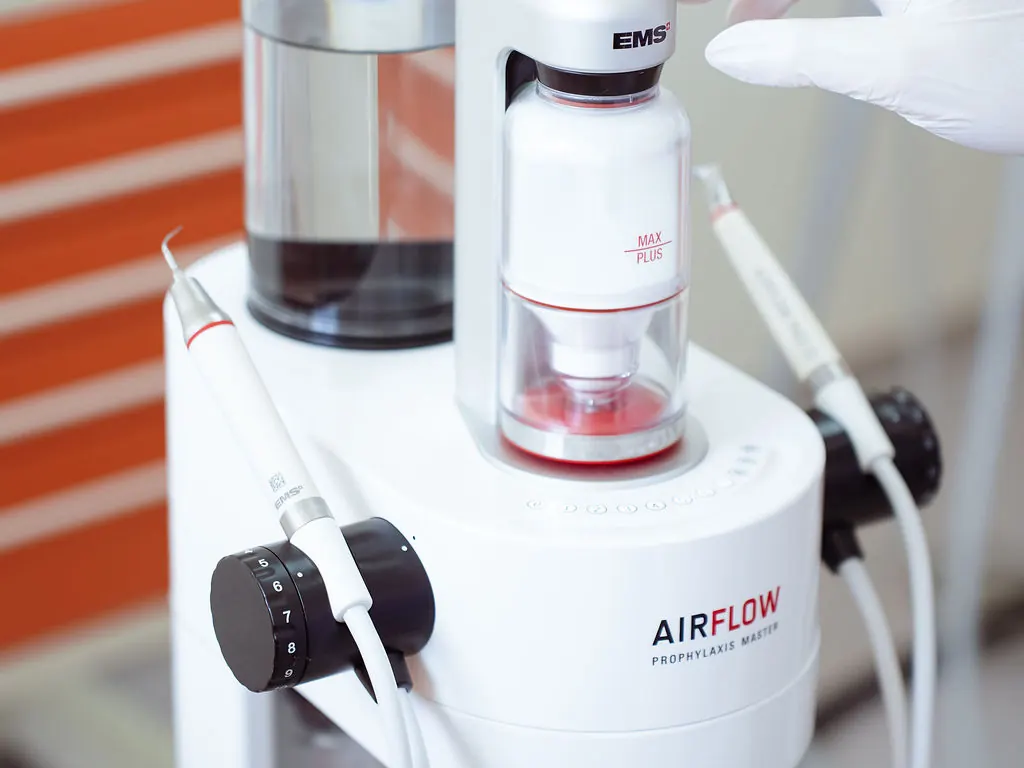
The EMS AIRFLOW® Prophylaxis Master uses warm water and a fine powder to remove biofilm. Many patients find this type of cleaning comfortable. Because tartar is removed only where necessary, ultrasonic instruments do not need to be used across every tooth surface.
Nevertheless, dental hygiene may still cause temporary discomfort, particularly if you have:
- Inflamed or sensitive gums.
- Exposed tooth roots.
- Sensitive teeth.
- Significant tartar deposits.
- Periodontal pockets requiring deeper treatment.
If you have sensitive teeth or have had an uncomfortable cleaning experience in the past, let your dental hygienist know before treatment begins. The procedure can be adjusted to your needs, and local anaesthesia may be considered when appropriate.
GBT is not guaranteed to be completely pain-free, but it is designed to provide thorough cleaning while prioritising patient comfort.
Who can benefit from Guided Biofilm Therapy?
GBT can be adapted to a wide range of patients, including those with particular dental hygiene needs.
Patients with sensitive teeth
Warm water, fine cleaning powder and individually adjusted equipment settings may help improve treatment comfort.
Patients with braces
Fixed orthodontic appliances create areas where plaque can accumulate more easily. AIRFLOW® technology allows effective cleaning around brackets and other orthodontic components that may be difficult to reach with a toothbrush.
Patients with dental implants, crowns and bridges
Maintaining good oral hygiene around implants and dental restorations is particularly important. When suitable instruments and techniques are selected, GBT can be adapted to clean around these restorations while taking their materials and surfaces into account.
Patients with surface staining
Coffee, tea, red wine and tobacco can cause visible stains on the teeth. AIRFLOW® helps remove these surface deposits, often leaving teeth looking cleaner and brighter. However, AIRFLOW® is not a teeth-whitening treatment – it removes external staining rather than changing the natural colour of the enamel. If you would like to make your teeth genuinely whiter, professional teeth whitening may be a more suitable option.
Patients with gum disease
GBT may be incorporated into an individual care plan for patients with gingivitis or periodontitis. However, routine preventive dental hygiene should not be confused with specialised periodontal treatment, which may require additional procedures. Your dental professional will recommend the appropriate treatment based on your oral health.
How to choose a good dental hygienist in Prague
When comparing dental hygiene providers in Prague, price and equipment should not be the only considerations. A high-quality appointment should involve several important elements.
- 1. Assessment of your teeth and gums – your hygienist should evaluate your oral health and identify any relevant risk factors before treatment.
- 2. Thorough removal of biofilm and tartar – effective dental hygiene is about more than making teeth look clean; it should focus on removing deposits that contribute to inflammation and other dental problems.
- 3. Personalised treatment – patients with healthy gums may need a different approach from those with braces, implants or periodontal disease.
- 4. Practical home-care advice – your hygienist should help you understand how to brush effectively and clean between your teeth using suitable interdental tools.
- 5. An individual follow-up recommendation – the recommended interval between visits should reflect your oral health rather than follow the same schedule for every patient.
These principles are central to the way we provide dental hygiene at Stomatologické centrum Anděl.
How much does dental hygiene cost in Prague?
The cost of professional dental cleaning in Prague varies between clinics. Pricing depends on factors such as appointment length, treatment requirements, the technologies used and the patient's oral health. When comparing prices, it is worth looking beyond the headline figure and considering what the appointment includes.
At Stomatologické centrum Anděl in Prague 5, our dental hygiene prices are:
| Treatment | Duration | Price |
|---|---|---|
| Initial GBT dental hygiene appointment | 60 minutes | CZK 2,200 |
| Regular GBT dental hygiene appointment | 45 minutes | CZK 1,750 |
What does the appointment include?
The initial appointment allows additional time to assess your oral health, provide professional cleaning and discuss your home-care routine. Regular appointments help maintain the results of preventive care.
Some patients may require additional procedures, such as deep cleaning of periodontal pockets. These are assessed individually and may involve a separate treatment plan.
For details of our other treatments, please see our dental price list.
How often should you have professional dental cleaning?
For many patients, an appointment approximately every six months is a reasonable starting point. However, there is no single schedule that is ideal for everyone. Patients with periodontal disease, dental implants, increased tartar formation or fixed orthodontic appliances may benefit from more frequent visits, while others with excellent oral hygiene and a low risk of dental problems may be advised to attend less frequently. Your dental hygienist can recommend an appropriate interval based on your individual circumstances.
Remember that professional cleaning complements daily brushing and interdental cleaning – it does not replace them.
GBT dental hygiene in Prague 5 – Stomatologické centrum Anděl
If you are looking for professional dental hygiene in Prague, we would be pleased to welcome you to Stomatologické centrum Anděl. Our clinic is located at Radlická 2000/3, Prague 5, approximately a three-minute walk from Anděl metro station.
We routinely use the Guided Biofilm Therapy protocol together with the EMS AIRFLOW® Prophylaxis Master. Rather than focusing only on removing plaque and tartar during a single appointment, we aim to help our patients maintain healthy teeth and gums in the long term.
Another advantage is the availability of comprehensive dental care under one roof. If your hygienist identifies a problem requiring assessment or treatment by a dentist, we can arrange appropriate follow-up care at our clinic.
Book your GBT dental hygiene appointment in Prague. Experience professional dental cleaning with modern GBT technology at our conveniently located clinic in Prague 5. Choose a suitable appointment time and book online.
Frequently asked questions about GBT dental hygiene
Scientific references
- Clinical efficacy of Guided Biofilm Therapy in the management of periodontal disease – a systematic review. BMC Oral Health, 2026. doi.org/10.1186/s12903-026-08418-z
- Guided biofilm therapy versus conventional protocol – clinical outcomes in non-surgical periodontal therapy. BMC Oral Health, 2024. doi.org/10.1186/s12903-024-04898-z
Related services